Terra-Aroma: Designing Porosity for Olfaction in Soil-Based Living Architecture
Student: Alireza Zamani Samani Advisor: Mae-Ling Lokko Committee Members: Anthony Acciavatti | Karla Neugebauer | Benjamin Chan Grants: ASCEND Initiative Grant / ReArc Institute Grant
Terra-Aroma investigates living soil as a multisensory medium for architecture. It asks how soil’s microbial life might participate in human habitation through smell, and how architectural design can shape that encounter. Emerging from nineteenth-century sanitary reform, the hygienist paradigm of modern architecture treated odorous organic matter as a sign of contamination. Deodorization became a material and spatial ambition, limiting porosity and obscuring the dependence of human habitation on microbial life. Soil offers a way to reconsider this separation through its longstanding role as both construction matter and living habitat.
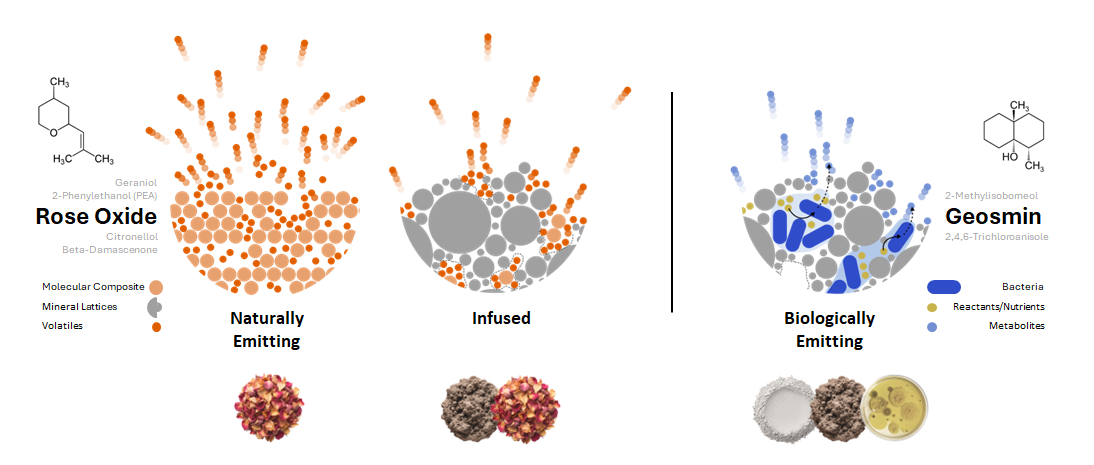
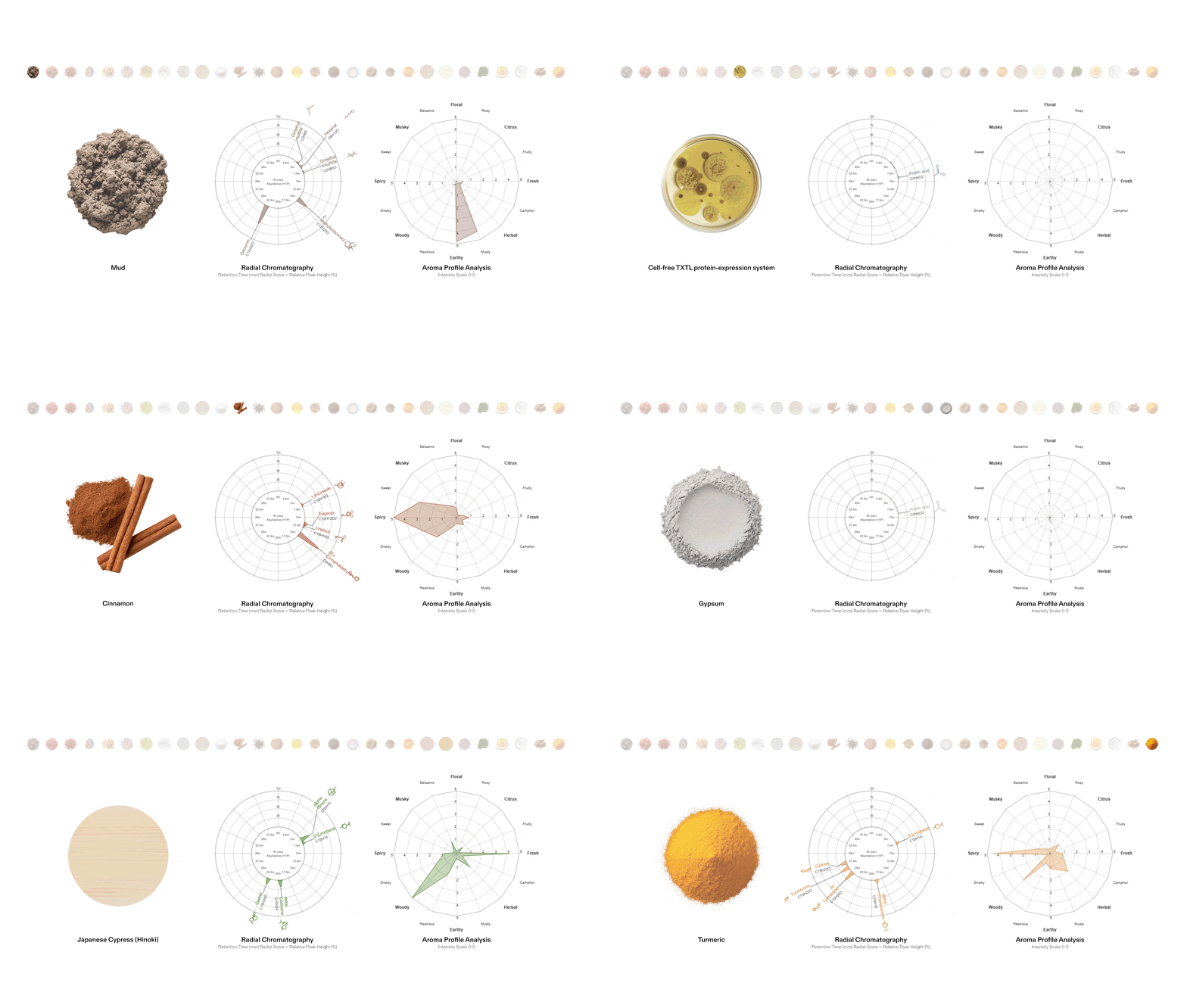
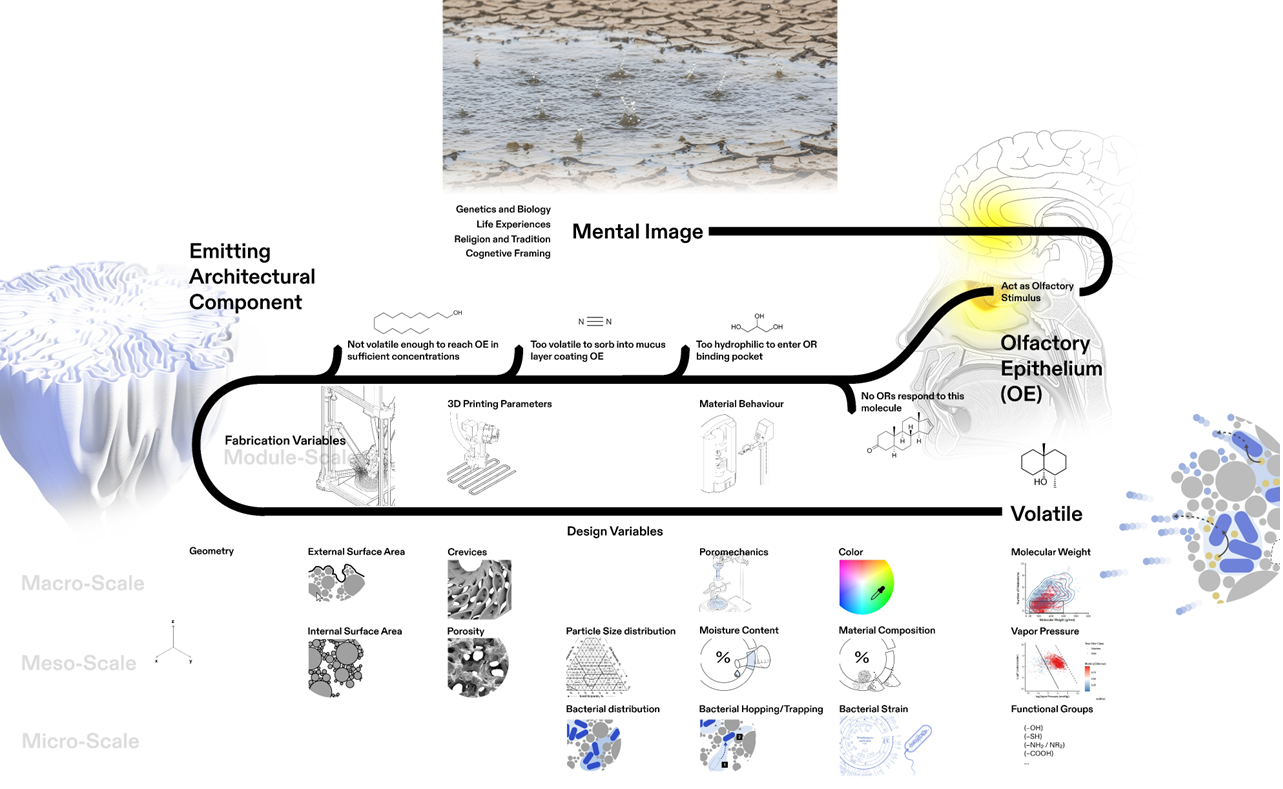
At the scale of an architectural component, geometry extends this investigation beyond the pore. Its configuration can alter exposed surfaces and shape the airflow that carries volatile emissions into inhabited space. The research follows this passage from microbial production to the encounter with smell, examining how architectural decisions might guide its release and spatial reach. Architectural demonstrators become settings for participatory smellwalking, connecting the design of living habitats with their sensory experience. The mental image evoked by the volatile is explored through individual memory and cultural association, connecting the experience of smell to the emitting object. This encounter with living soil offers a way to reconsider architectural cohabitation through the sensory presence of its microbial life.
Retooling Hybrid Earth Construction Systems for Circularity and Labor Access
Student: Oswaldo Chinchilla Advisor: Mae-Ling Lokko Committee Members: Anthony Acciavatti | David Gissen
Grants: ASCEND Initiative Grant | ReArc Institute Grant
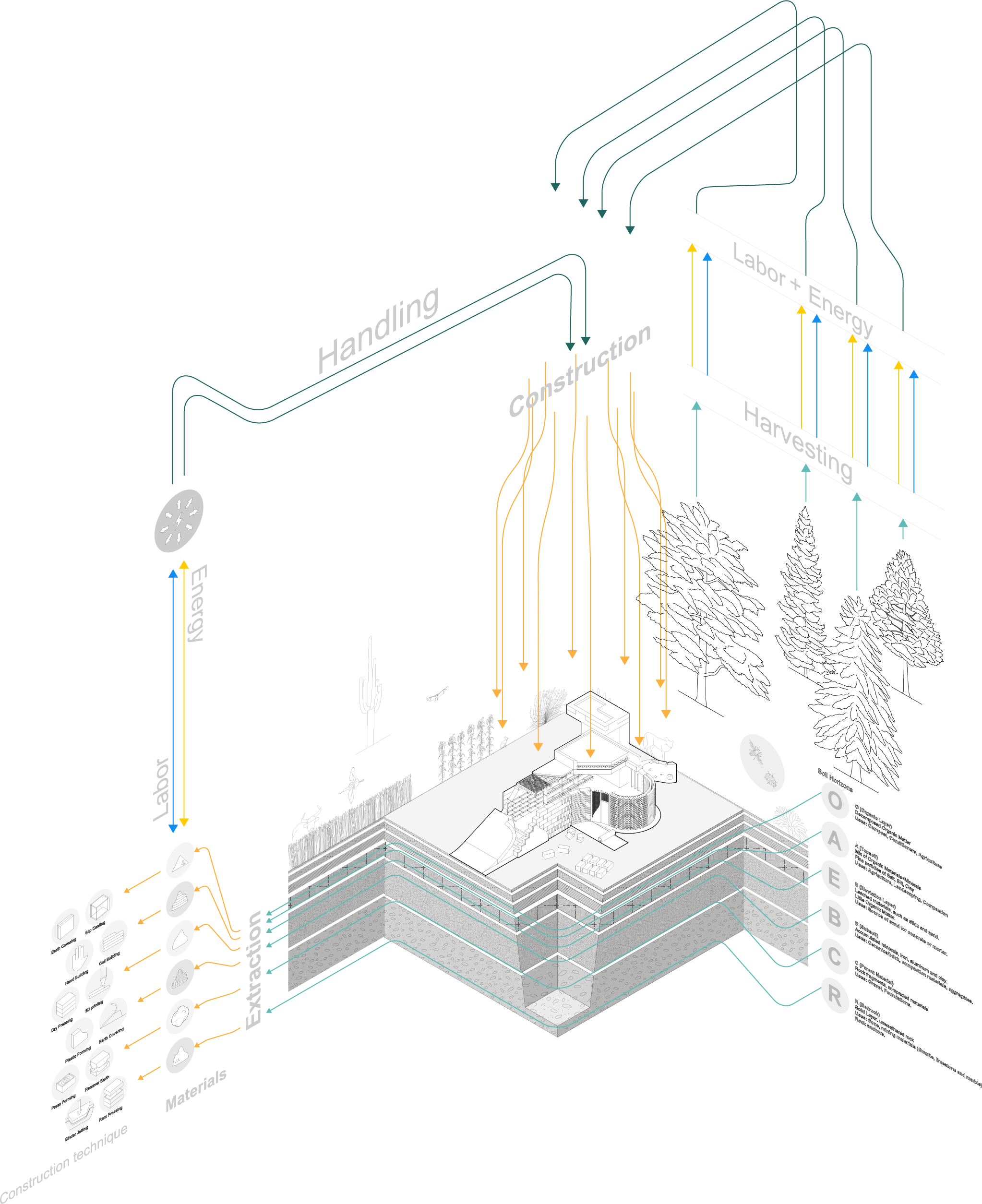
Retooling Hybrid Earth Construction investigates the tool as the link between material, skill, and labor in earthen architecture. It asks how tool design might bring hybrid earth systems up to contemporary performance standards while keeping their production open to builders who aren’t specialists. Consolidated through nineteenth-century industrialization, modern construction swapped natural fiber and clay matrices for cement binders, raised the capital cost of tools, and concentrated labor into specialized trades. The apprenticeship structures that carried earthen building knowledge dissolved along with them. Retooling offers a way to reconsider this separation through earth’s longstanding role as a circular, locally sourced, and collectively built material.
Method
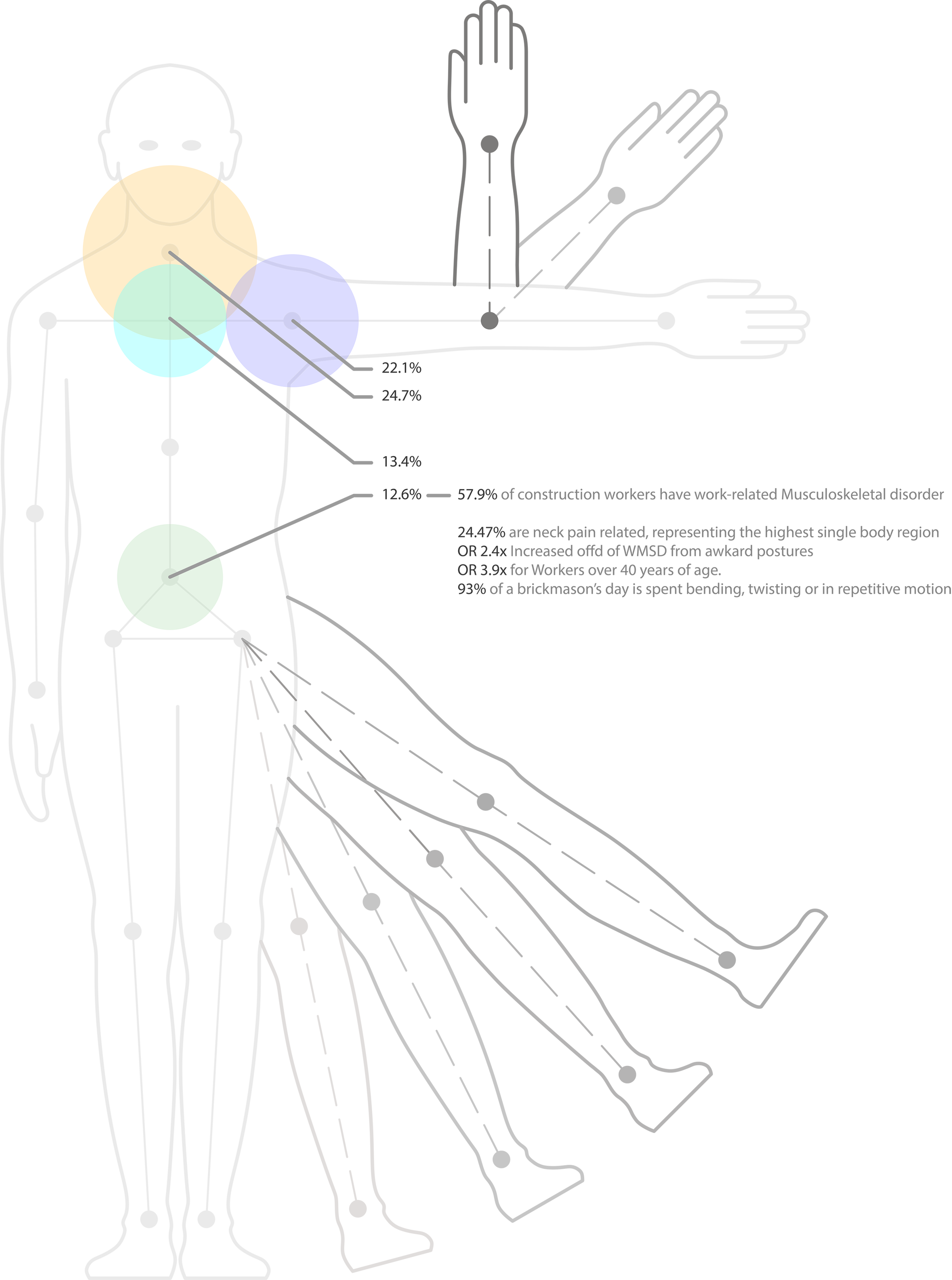
The research sorts historical and contemporary earthen tools by mechanism (compaction, extrusion, molding, and assembly) and prototypes variants of each, from hand tool to technology-aided machine. Each prototype is tested twice. A mechanical test measures compaction strength and repeatability against a conventional baseline tool. A human test has participants complete the Nordic Musculoskeletal Questionnaire before and after use to measure strain across force, posture, and repetitive motion. A tool that performs only in expert or unusually strong hands hasn’t solved the access problem. Only tools that clear both thresholds go on to building-scale prototypes.
Programmable Weathering of Climate-Responsive Earth Masonry Systems (CEMs)
Student: Laetitia Morlie Advisor: Mae-Ling Lokko Committee Members: Elihu Rubin | Keller Easterling Grants: ASCEND Initiative Grant | ReArc Institute Grant
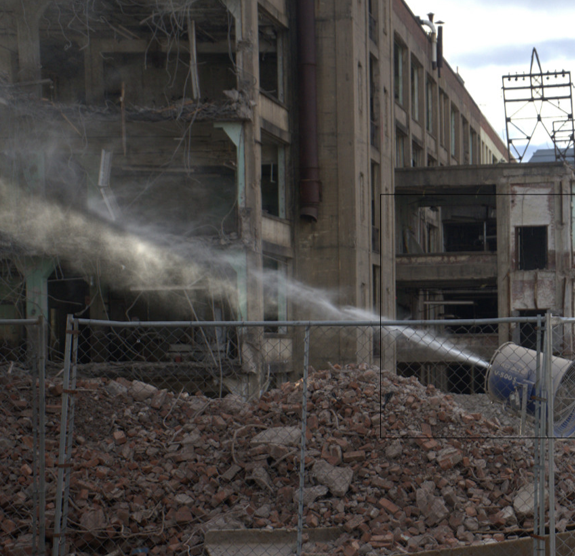
Composite earth masonry buildings have the potential to last for centuries, even millennia, while reducing embodied carbon by approximately 50% relative to conventional concrete masonry systems. Despite their reemergence as 21st-century circular, low-carbon solutions, their widespread adoption is hindered by concerns over weathering and maintenance. Paradoxically, high-carbon concrete masonry continues to dominate, valued for their perceived durability shaped by contemporary paradigms that frame building lifespans within 30–50-years - promoting obsolescence over cyclic repair (Abramson, 2016). At both ends of the building life cycle, the costs of short-lived constructions are staggering: each year 54700 million tons of construction materials are produced and 672 million tons of building waste are discarded, significantly contributing to soils degradation.
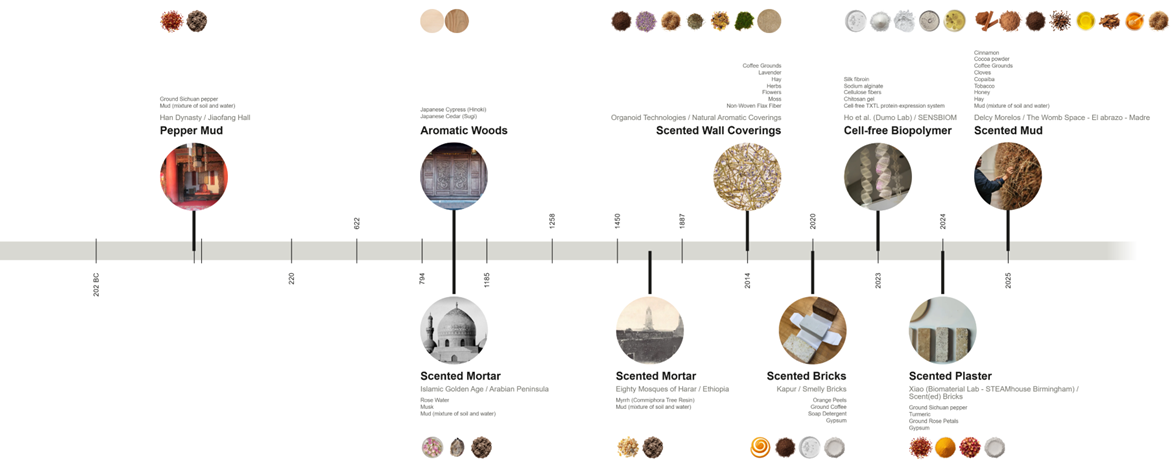
Drawing on Living Systems Theory, the research approaches the soil-based building envelope as a living membrane, a critical zone of exchange that sustains microbial inhabitants while mediating their relationship with the surrounding environment. Here, smell emerges through volatile microbial metabolites, making biological activity perceptible without direct contact with its source. This olfactory presence is considered alongside soil’s visual and tactile qualities, locating multisensory experience within the material’s ecological life. Designed porosity is central to this inquiry because it influences the conditions in which microorganisms persist and the pathways through which their emissions reach the air.Terra-Aroma investigates living soil as a multisensory medium for architecture. It asks how soil’s microbial life might participate in human habitation through smell, and how architectural design can shape that encounter. Emerging from nineteenth-century sanitary reform, the hygienist paradigm of modern architecture treated odorous organic matter as a sign of contamination. Deodorization became a material and spatial ambition, limiting porosity and obscuring the dependence of human habitation on microbial life. Soil offers a way to reconsider this separation through its longstanding role as both construction matter and living habitat.
Three Lifecycles
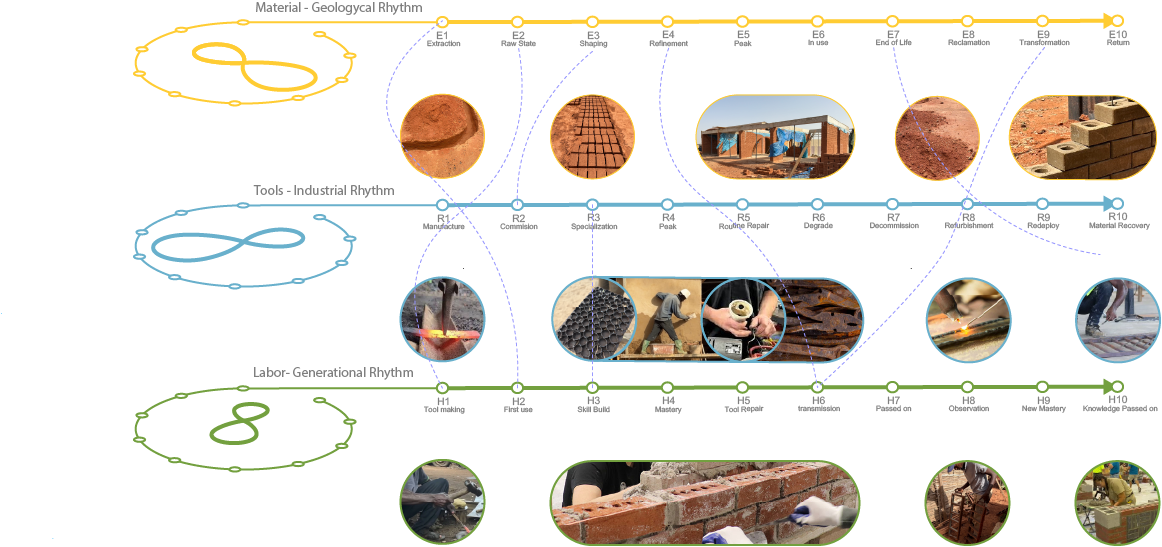
In hybrid earthen construction, building knowledge survives only as long as three lifecycles stay bound together: materials, tools, and labor. Circular, locally sourced materials make experimentation affordable and low-risk. Tools set the skill threshold for who can build. Collective labor and apprenticeship carry the tacit knowledge that a specification can’t capture, such as how moisture, gradation, and compaction feel in the hand. Industrialization pulled these three apart for the sake of speed and permanence. This research treats retooling as a way to bring them back together.
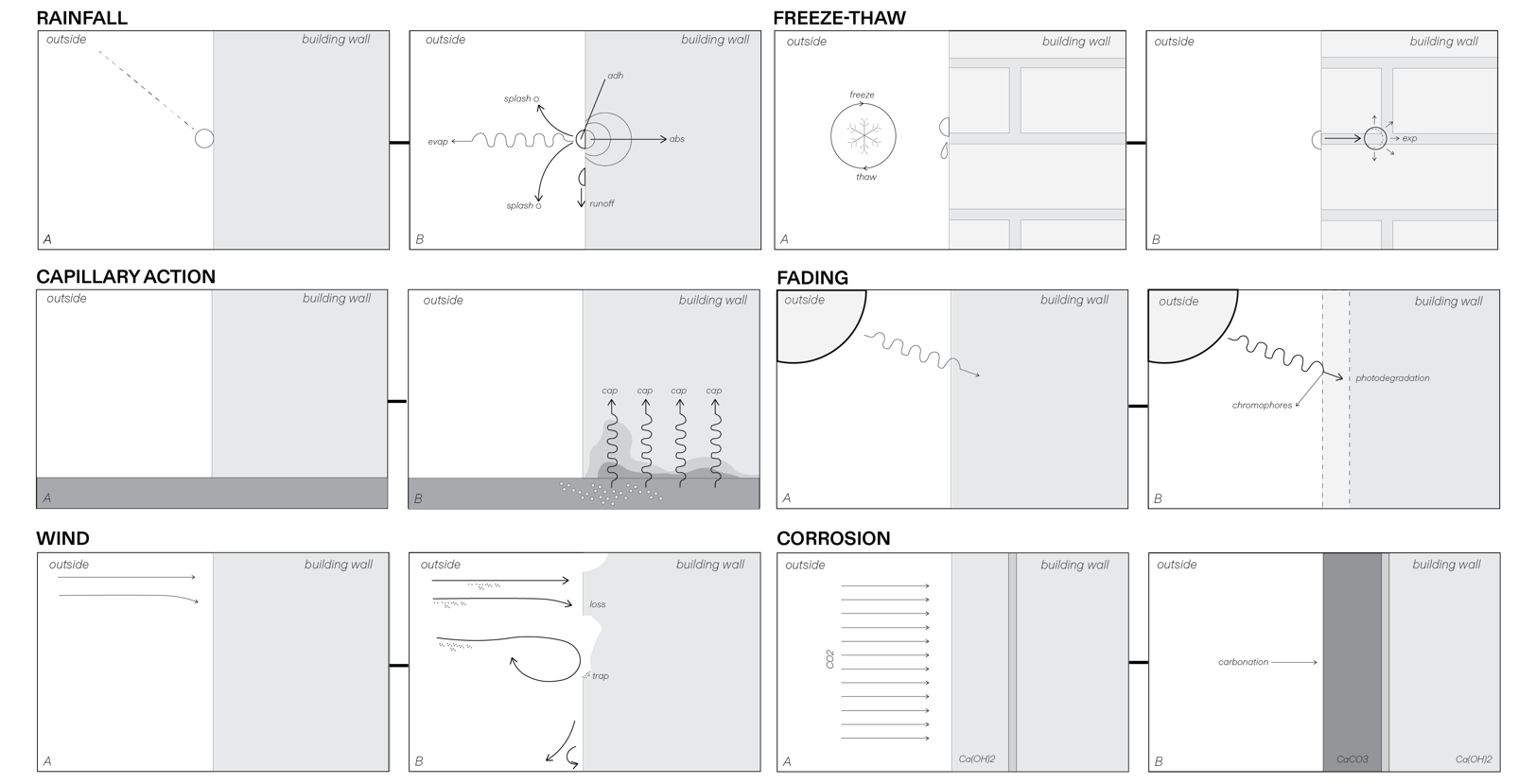
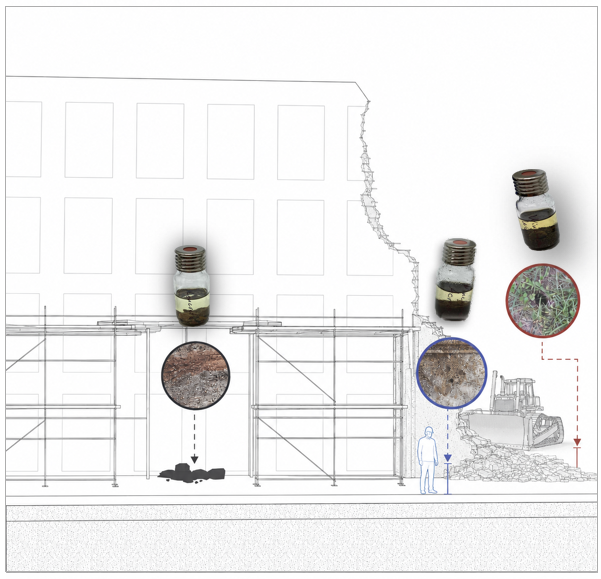
To meet today’s demand for concrete masonry systems, contemporary earth construction risks perpetuating extractive logics and overlooking soil health across its life cycle - increasing the contamination and carbon depletion of further soil horizons. Recent advances in the manufacturing of earthen systems primarily address weathering through synthetic binders, stabilizers, and waterproofing agents. However, such additives contain harmful volatile organic compounds (VOCs) and heavy metals leachates, creating critical bottlenecks to circular practices. In response, this research proposes a design framework for the programmable weathering of composite earth masonry systems (CEMs) linking different rates of material weathering with building performance metrics and leachate properties. Rather than resisting weathering, this approach embraces it as a dynamic process - treating material transformation as a design opportunity to rethink building and site environmental health across scales.
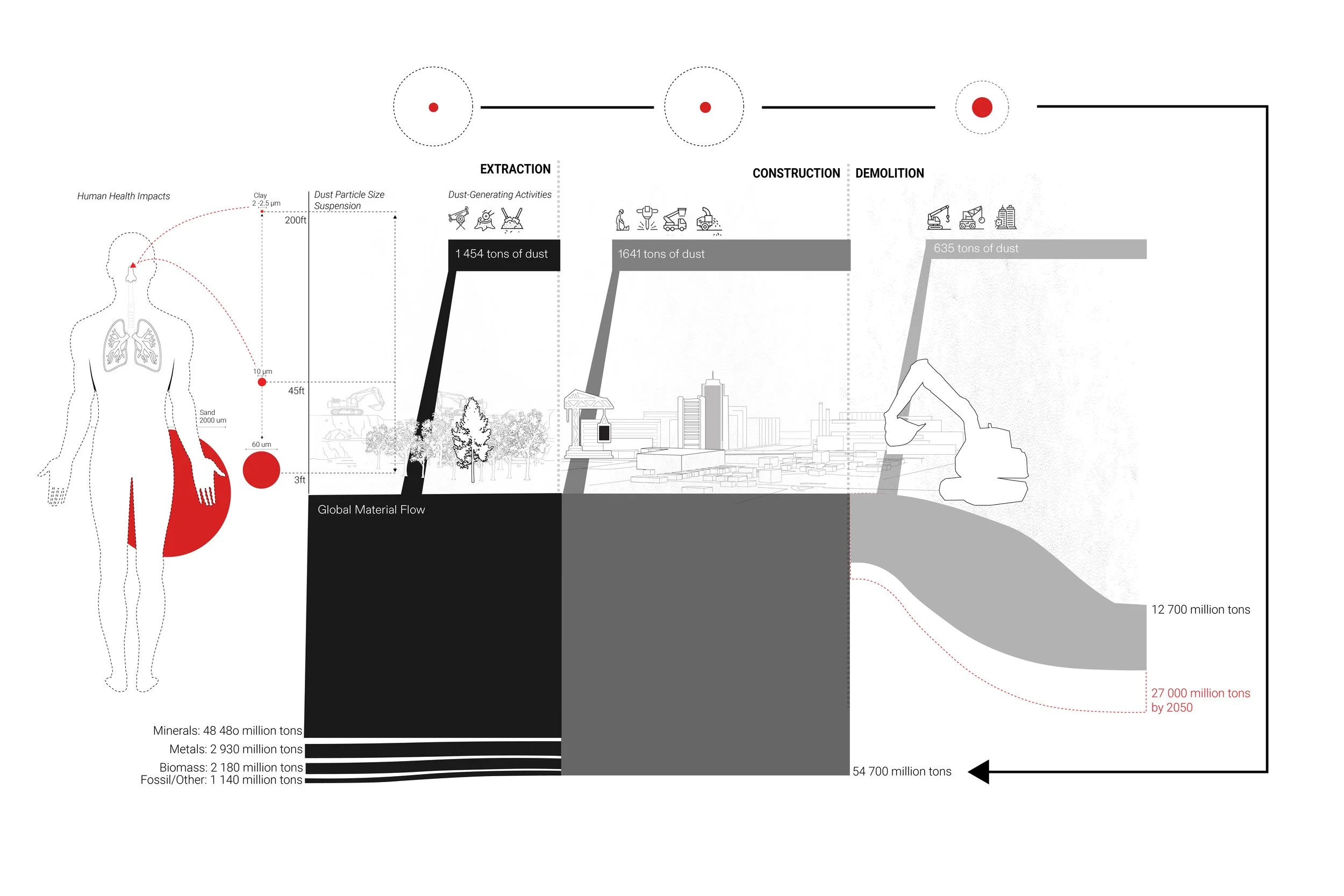
The aims of this research are threefold: (1) to develop and evaluate the near-term mechanical and weathering properties of composite masonry systems using construction and demolition waste (CDW) and biobased additives and coatings, (2) to investigate the mid-term building integrated performance of these composite earth-masonry systems (CEMs), and (3) to evaluate the afterlife of toxic materials towards healthier building material aggregates.